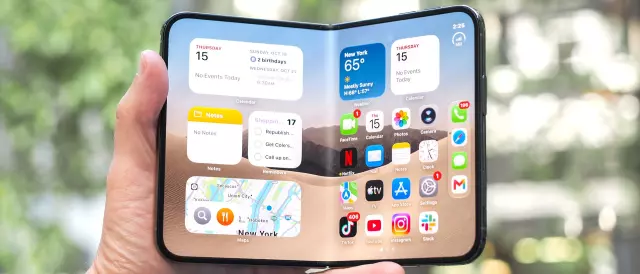
I tested the iPhone Duo for a week — my favorite foldable yet, but there's a catch
- Tags
- iPhone Duo
- Apple
- iOS 27
- foldable phone
- Tech Reviews
Introduction to Apple's First Foldable
I honestly haven’t been this excited about a new iPhone since the iPhone X nearly a decade ago. The iPhone Duo finally gives Apple fans a foldable phone, and there’s something really cool about having a 5.4-inch iPhone that transforms into a 7.6-inch mini tablet in your pocket, complete with dual-app multitasking. Finally!
Apple’s first foldable phone doesn’t look or feel like a first attempt, either, because of the sheer attention to detail. The way the friction hinge holds nearly any angle, the seamless switching between the cover and main display with the same aspect ratio, and the nano-texture coating which minimizes glare and the dreaded crease, all contribute to an incredible device. It feels like playing with a $2,000 Transformer.
However, the Duo name is apt because I’m of two minds about it. While the first wave of iPhone Duo apps look great, many third-party apps aren’t optimized for this form factor yet. And then there’s the trade-offs versus the iPhone 18 Pro Max, such as the lack of a telephoto zoom and Face ID. Let's dive deep into my full week living with this device.
Who is the iPhone Duo for?
The iPhone Duo is designed for people who want a large screen on the go for watching videos and playing games, as well as for heavy multitaskers who want to run two apps simultaneously. It bridges the gap between a compact smartphone and a portable tablet in a single device—provided you are willing to pay a hefty $2,000 premium.
During my commute, I frequently used the iPhone Duo to catch up on Slack while streaming videos in another window, and I could open large spreadsheets without endless scrolling. Business travelers, in particular, will find a lot to love about this foldable form factor.
Design and Build Quality
Holding the iPhone Duo for the first time immediately gives off a classic iPhone feel. While the passport design has been explored by competitors like the Samsung Galaxy Z Fold 8, Apple’s iteration feels a step ahead. The asymmetrical design features a flat left side and rounded corners on the right, enabling identical 1.4:1 aspect ratios on both the cover and main displays.
The polished titanium frame provides superior durability over aluminum, and the device rests more steadily on flat surfaces. Closing the phone delivers a satisfying clasping sound, powered by alignment magnets.
Though it is the thinnest iPhone when opened at 5.2mm, it remains a bit chunky when closed compared to competitors, measuring thicker than the Galaxy Z Fold 8. Despite the extra heft, it slips easily into a front pocket without weighing you down, and boasts an impressive IP68 dust and water resistance rating.
Display and the Nano-Texture Panel
The iPhone Duo features a matte nano-texture finish on its main interior screen, utilizing an advanced polymer that significantly reduces glare and offers a paper-like reading experience for ebooks. However, it comes with a compromise: while brightness reaches nearly 2,600 nits with HDR content, the matte coating mutes absolute black levels and color saturation compared to a traditional glossy OLED panel.
The crease on the main display is brilliantly hidden, making it nearly imperceptible unless viewed under harsh, angled lighting. Meanwhile, the outer 5.4-inch cover screen uses a vibrant, glossy OLED panel ideal for one-handed messaging and social media scrolling.
Audio Performance
Audio delivery is surprisingly robust. Apple positioned the speakers so that when opened, they sit on the top left and bottom right, creating a much more balanced stereo soundstage compared to competitors that cluster speakers on one side. Music playback yields rich bass and full-bodied clarity.
Touch ID vs. Face ID
Dropping Face ID in favor of Touch ID embedded within the oversized power button feels like a step backward. While Touch ID works reliably, it introduces a subtle, noticeable lag when unlocking the device compared to facial recognition. Apple Watch integration helps streamline unlocking, but it still falls short of the speed users expect from flagship iPhones.
Software and Split View Multitasking
Running a custom version of iOS 27 optimized for folding screens, the UI shifts key status bar elements and controls dynamically. Split-View multitasking is exceptionally intuitive; swiping up on an active app lets you dock it neatly to either side of the screen.
App pairs can be saved effortlessly, though rotating the device into portrait mode temporarily collapses Split View down to a single app window. Left-handed users may also find the fixed right-side dock placement a bit frustrating since it cannot be manually relocated.
App Optimization
Apple’s native applications look stunning in multi-column layouts, and optimized third-party tools like Slack and Netflix leverage the tablet-sized canvas brilliantly in tabletop mode. However, unoptimized apps still suffer from pillarboxing or awkward scaling, though developers are rapidly updating their libraries to avoid awkward blank spaces.
Camera Capabilities and Zoom Trade-Offs
The iPhone Duo features a dual 48MP camera setup (Main and Ultrawide) that captures stellar low-light shots, vibrant portraits, and clean selfies. Features like Smart Take—which automatically snaps group shots based on poses—add genuine utility.
The notable omission, however, is a dedicated telephoto zoom lens. Zooming past 8x reveals a drop in sharpness compared to traditional pro-tier slab phones, meaning mobile photography enthusiasts heavily reliant on optical zoom will feel the pinch.
Performance and Thermal Management
Powered by top-tier silicon, the iPhone Duo matches the snappy performance of its non-foldable counterparts. It handles intensive mobile gaming and simultaneous split-screen workflows without missing a beat. Integrated vapor chamber cooling ensures heat is dissipated evenly across the chassis during sustained gaming sessions.
Battery endurance is respectable, pushing past 13 hours in structured web-browsing tests and comfortably lasting a full day of mixed-use workflows.
The Verdict
The iPhone Duo is arguably the best-designed foldable phone on the market, offering robust hardware, clever software modes, and an innovative crease-minimizing display. While sacrifices in optical zoom, biometric authentication, and color vibrancy due to the matte coating are frustrating at a $2,000 price point, the polished execution makes it an incredible milestone for Apple.
Comments (0)
Sign in to join the conversation.Sign in
Loading comments...