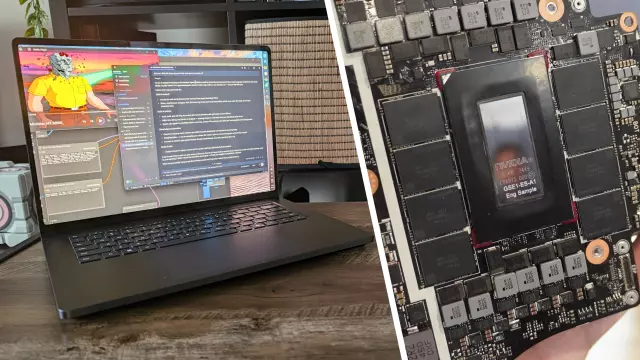
Nvidia RTX Spark Benchmarks: The GPU That Redefined Laptop Performance
- Tags
- Gaming
- AI
- Laptops
- Computing
- Hardware
- Nvidia
- RTX Spark
- Benchmarks
A New Frontier in Mobile Computing
The tech industry has spent months building hype around Nvidia's new RTX Spark platform, a hardware integration that pairs an Arm-based Grace CPU with a potent Blackwell-architecture RTX GPU. Often labeled as a 'MacBook Pro killer' by analysts, I have spent the last week putting this hardware—specifically in the form of the Microsoft Surface Laptop Ultra—through its paces.
CPU Reality Check: Apple Remains the Gold Standard
If you were hoping that Nvidia’s Grace CPU would completely dismantle Apple’s M5 Pro in raw compute power, the results are a reality check. While impressive for an Arm-based Windows machine, it falls short of Apple’s current silicon leadership in single-core performance. In our Geekbench 7 testing, the M5 Pro maintains a comfortable lead in both single and multi-core efficiency.
Gaming Performance: The GPU Flex
Where the RTX Spark truly shines is in the GPU department. This is not just a modest mobile upgrade; it is a graphical powerhouse. When running 3DMark benchmarks, the RTX Spark effectively matches the output of a dedicated RTX 5070 gaming laptop.
Crucially, the system manages to maintain this level of performance even when running on battery power. During testing with Forza Horizon 6 and Cyberpunk 2077, the RTX Spark demonstrated consistent frame rates and frame times, whether plugged into the wall or operating on battery—a feat that has historically been the sole domain of Apple Silicon devices.
Creative and AI Performance
Beyond gaming, the platform excels in creative workflows and AI processing. In PugetBench tests for Photoshop and Premiere Pro, the RTX Spark represents a significant step forward for Windows devices, comfortably leading its non-Apple competitors.
Furthermore, when testing against local AI models like Llama 3.1 and Phi 3.5 using the UL Procyon benchmark, the RTX Spark demonstrated impressive tokens-per-second throughput. It effectively bridges the gap between traditional laptop performance and desktop-class AI capabilities.
Battery Life: The Trade-off
While the performance parity on and off the charger is revolutionary for Windows users, the battery life is a 'mixed bag.' It delivers a solid 10-hour experience for general web browsing, but it cannot compete with the 20+ hour longevity offered by the 16-inch MacBook Pro. For heavy gaming, you can expect just over an hour and a half of intensive use, which, while better than typical gaming laptops, is a stark reminder of the power draw required by a Blackwell-class GPU.
Conclusion: Who is this for?
If you are a creative professional or a power user who requires large-model AI local processing and high-end graphics performance without being tethered to a wall, the RTX Spark platform is a game-changer. It leverages unified memory architecture to manage massive projects and AI datasets in ways that standard Windows laptops cannot. However, for those seeking the ultimate balance of battery endurance, Apple’s M5 Pro ecosystem remains the reigning champion.
Comments (0)
Sign in to join the conversation.Sign in
Loading comments...