



9 out of 10 French people fail to detect fake news, even when faced with a basic test.

As information circulates at unprecedented speed on social media and digital platforms, distinguishing fact from fiction is becoming increasingly complex. Between viral content, deepfakes generated by Grok, and the proliferation of sources, the media landscape is evolving rapidly.
Indeed, a recent study conducted by Ifop for Cision sheds light on this reality. Just days before Media and Information Literacy Week, the results highlight a widespread vulnerability to fake news, affecting the entire French population…
A large majority of French people struggle with fake news
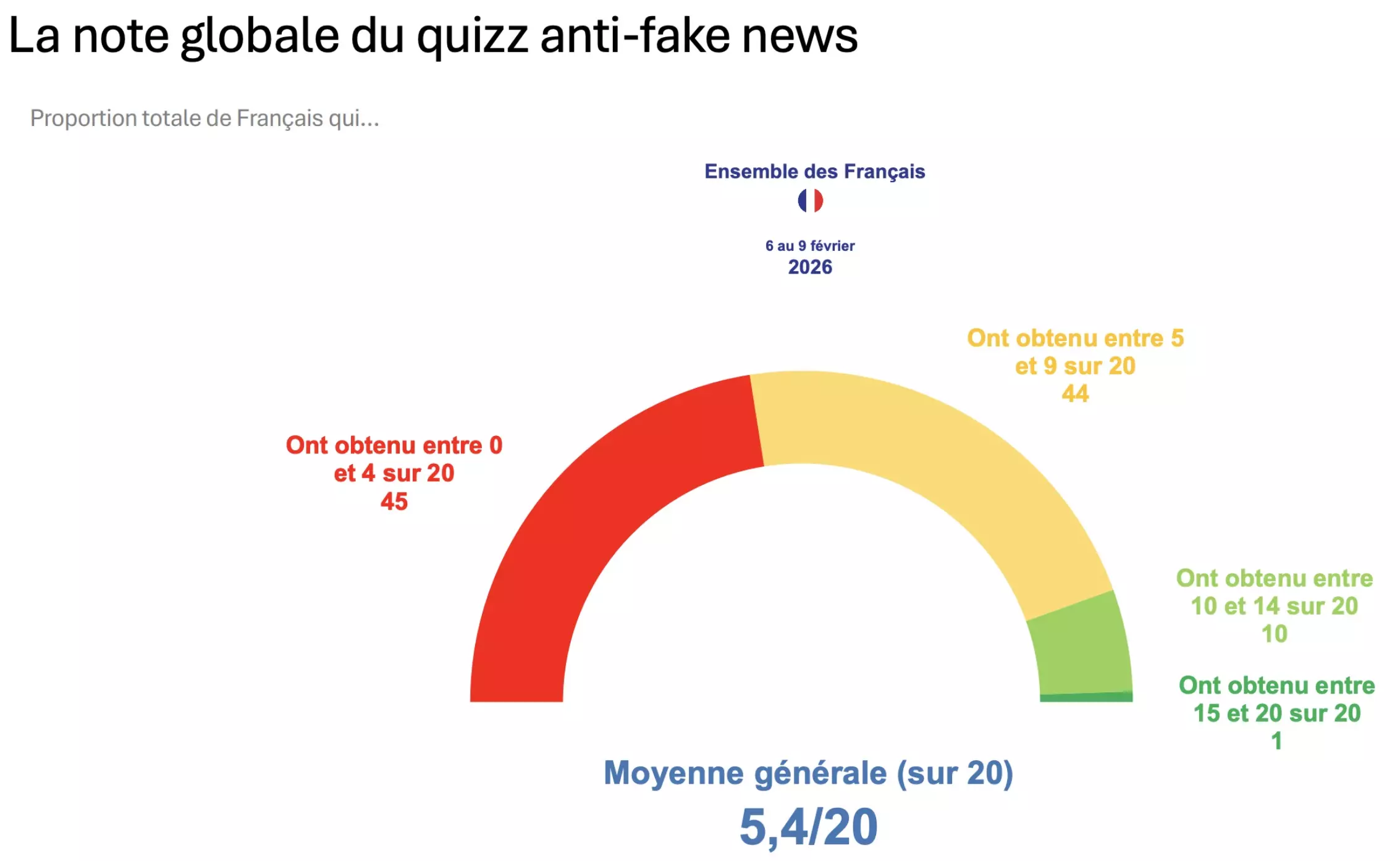
The overall average is very worrying – Source: Ifop
Based on a quiz called "Anti Fake News," designed by journalist Thomas Huchon, the French obtained an average score of 5.4 out of 5. 20. In fact, 89% of participants do not reach the average score, and only 1% exceed 15 out of 20. These results show how difficult identifying misleading content remains for the majority of citizens. Contrary to some preconceived notions, this vulnerability affects the whole of society, and social categories, political orientations, or even geographical areas do not act as true bulwarks against disinformation. As Thomas Huchon points out, "we are all potential victims of these phenomena." Differences according to age, education, and social media use: While the difficulty is widely shared, the study highlights several differences depending on individual profiles. Thus, Generation Z achieves the least weak results, with an average between 6.3 and 6.7 out of 20, while scores gradually decrease with age. People aged 65 and over thus achieve approximately 4.8 out of 20. Educational attainment also plays a role, as those with a higher education degree obtain an average of 7.6 out of 20, compared to 4.4 out of 20 for those without a high school diploma. Furthermore, as a European survey showed, social media use appears to be a determining factor, with those who spend less than two hours a day on social media achieving an average of 5.6, compared to 4.9 for those who spend more than five hours a day. Finally, information practices influence the results, as consumers who regularly consult the national daily press or who diversify their information sources obtain slightly higher scores. AI further complicates the identification of content…
The study also highlights a growing difficulty linked to the emergence of generative AI.
For example, one quiz question concerned the recognition of faces created by AI. The results show that 97% of participants provided an incorrect or incomplete answer. This figure illustrates the increasing complexity of distinguishing synthetic content from authentic images.
This development also raises economic issues, as it is estimated that disinformation will represent more than $400 billion in costs worldwide by 2024.
Faced with this trend, at a time when content creation tools are becoming ever more sophisticated, the ability to analyze information is now emerging as a skill in its own right…
Please Login to leave a comment.
Want to Post Your Topic
Join a global community of creators, monetize your content easily. Start your passive income journey with Digbly today!
Post It Now
Comments