



Advertising market 2026: growth of +9% and a strengthened dominance of digital

In a tense economic context marked by persistent geopolitical uncertainties, the global advertising market continues to show solid momentum.
This is one of the main findings of the 5th edition of the study "A World Without Bias – Global Media Landscape 2026", published by Havas Media Network in partnership with RTL AdAlliance…
Growth driven by major economies
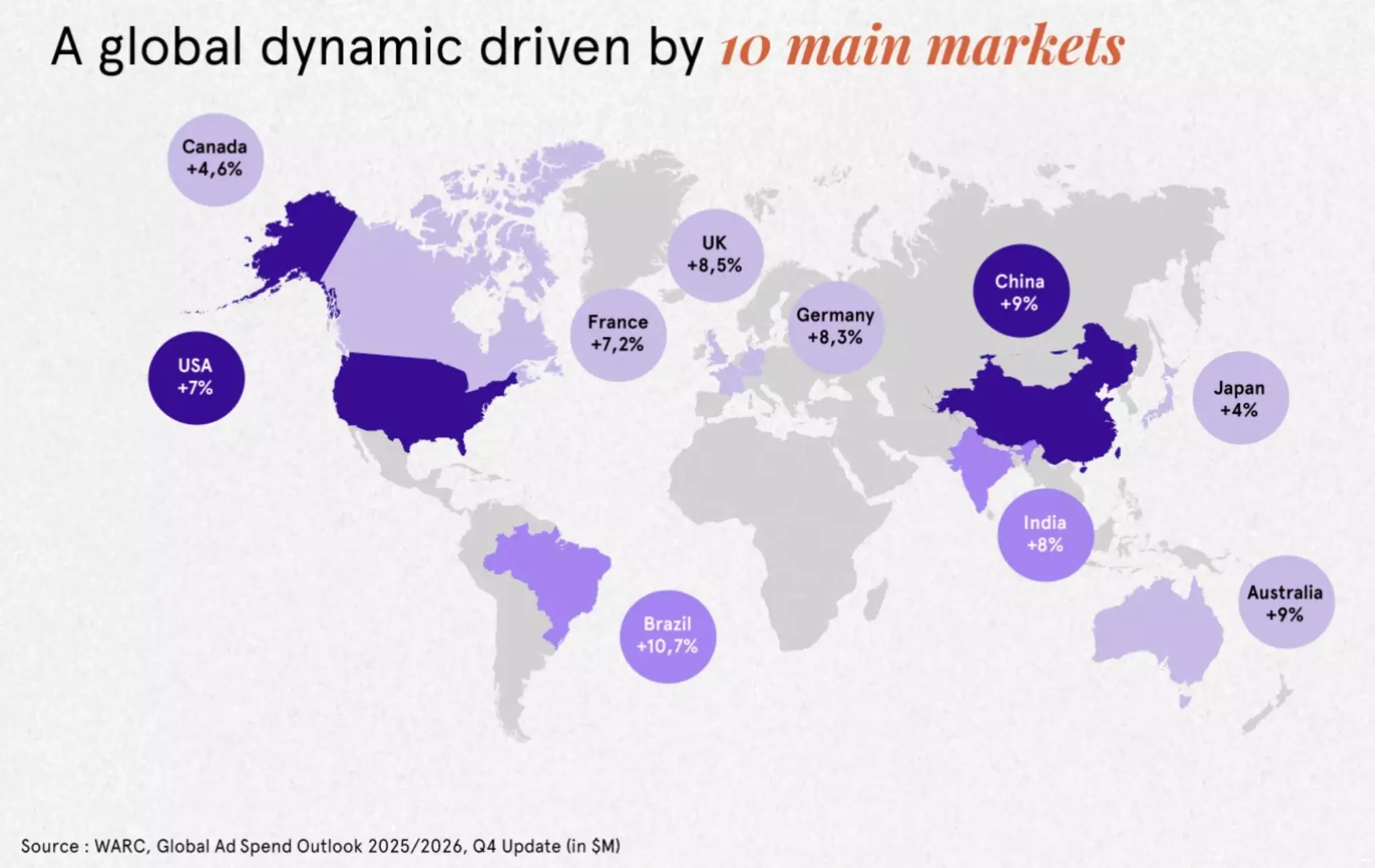
Momentum driven by certain countries?
– Source: Havas Media Network / RTL AdAllianceGlobal advertising spending is expected to reach $1.3 trillion in 2026, an increase of 9.1% compared to 2025. This growth could continue in 2027, with expected growth close to 8%.
This momentum is driven by several key markets: the United States with 7%, the United Kingdom with 8.5%, France with 7.2%, Germany with 8.3%, India with 8%, and Brazil with 10.7%. Major sporting events, such as the World Cup held in North America, should also support this acceleration.
Promising sectors for advertising?
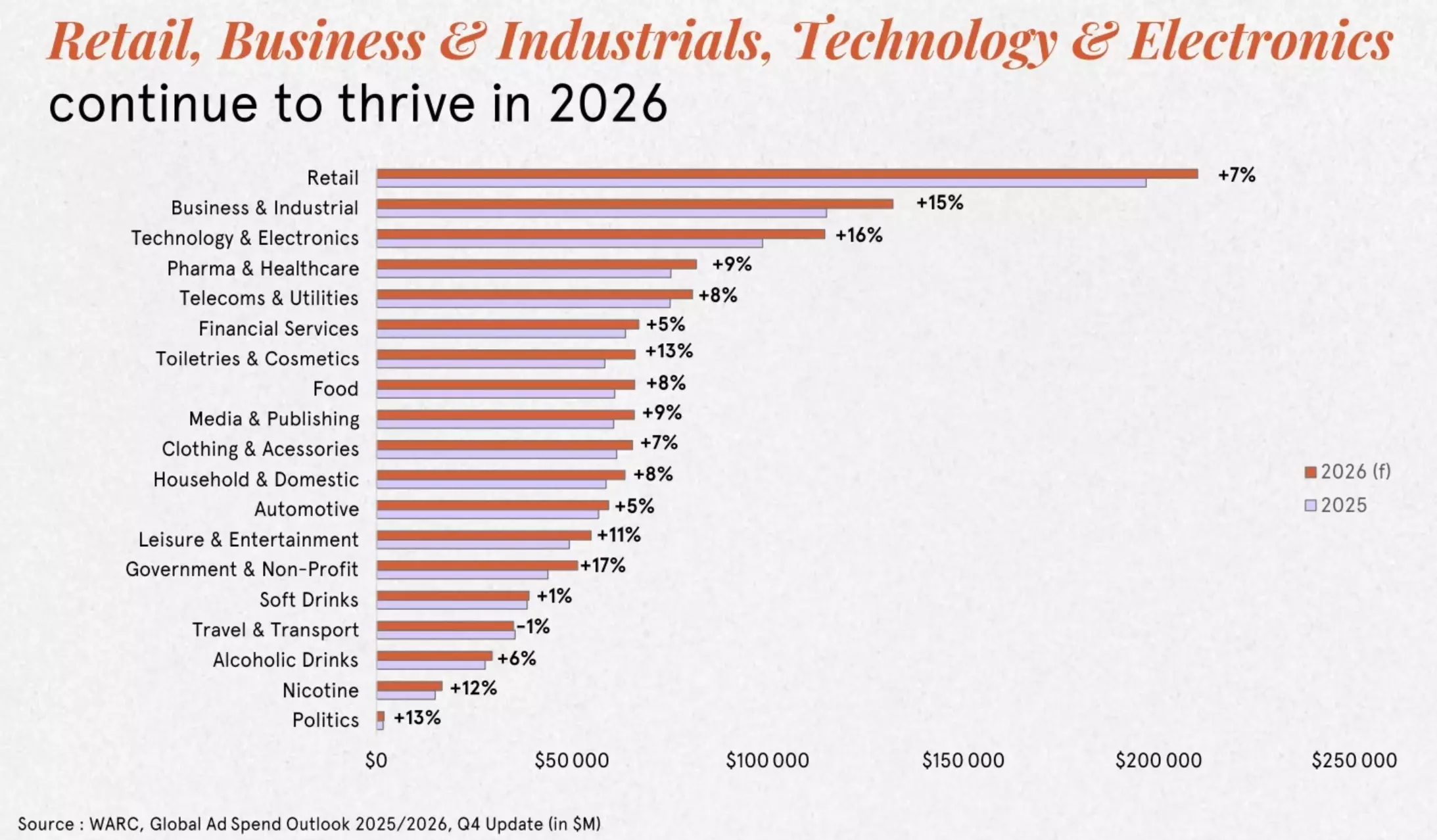
Retail, a prime sector?
– Source: Havas Media Network / RTL AdAllianceIn terms of sectors, technology and electronics showed the strongest growth at +16%, followed by business and industry at +15%, and retail at +7%.
digital now accounts for 81% of global investments and remains the only segment experiencing strong growth at +12%. Meanwhile, offline media is stagnating, while market concentration has reached unprecedented levels. Alphabet, Meta, and Amazon alone represent 63% of global growth excluding China.
Between delinearization, nostalgia, and the rise of AI
Paradoxically, while digital budgets are exploding, usage patterns are evolving. 73% of Europeans believe that major platforms have lost their ability to create social connections, and 92% of Gen Z members say they want more real-life interactions. Faced with this trend, brands are already responding with immersive experiences, pop-up stores, and community activations, in a kind of analog renaissance where physical experience becomes a differentiating factor. Television, meanwhile, is becoming non-linear. Creators from YouTube are now producing content with budgets approaching those of traditional television. For example, co-streaming attracts between 100,000 and 300,000 live viewers in France, particularly in sports and entertainment. Artificial intelligence is also emerging as a strategic lever, so much so that by 2026, one billion people will be using generative AI tools, even though only 3% will pay a subscription, thus paving the way for monetization. Furthermore, data is becoming central: 54% of French people say they share their information to benefit from these technologies. On Amazon, 38% of consumers use AI to guide their purchases, and 40% of French people rely on these tools in their purchasing decisions. Beyond the "agentic" e-commerce offered by ChatGPT, "conversational shopping" is gradually establishing itself as a new, structuring channel…
Comments