



Behind ChatGPT lies a very Anglophone mechanism that penalizes European companies

When a user queries ChatGPT in German, Spanish, or Polish, they logically expect to get answers rooted in their local market.
And yet, a new analysis by the company Peec AI shows that the reality is quite different. Behind the conversational interface, ChatGPT conducts a large portion of its searches… in English.
43% of internal searches performed in English
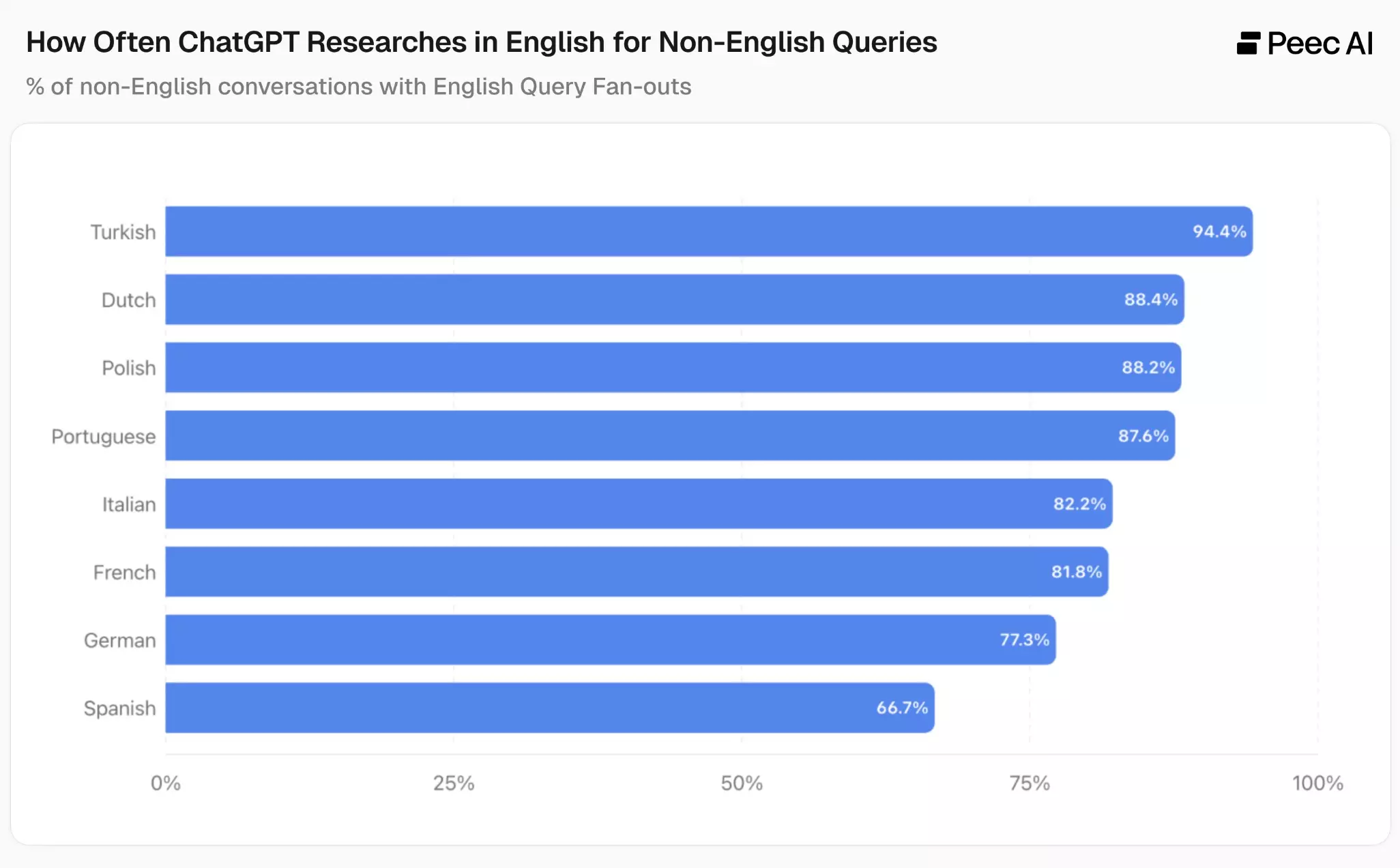
English search still dominates on ChatGPT – Source: Peec AI
To understand this phenomenon, Peec AI analyzed more than 10 million queries and 20 million fan-out queries, these sub-queries generated automatically by ChatGPT when it searches for sources on the web.
According to the report, 43% of these internal queries are made in English, even when the initial question is asked in another language. But even more revealing, in 78% of the cases studied, an English search occurs at least once in the response construction process.
Furthermore, the methodology excluded ambiguous cases, such as a query in German from the United Kingdom. Unfortunately, the findings are undeniable, showing that no non-English language falls below 60% of queries enriched with English.
Invisible local leaders… to the benefit of international players
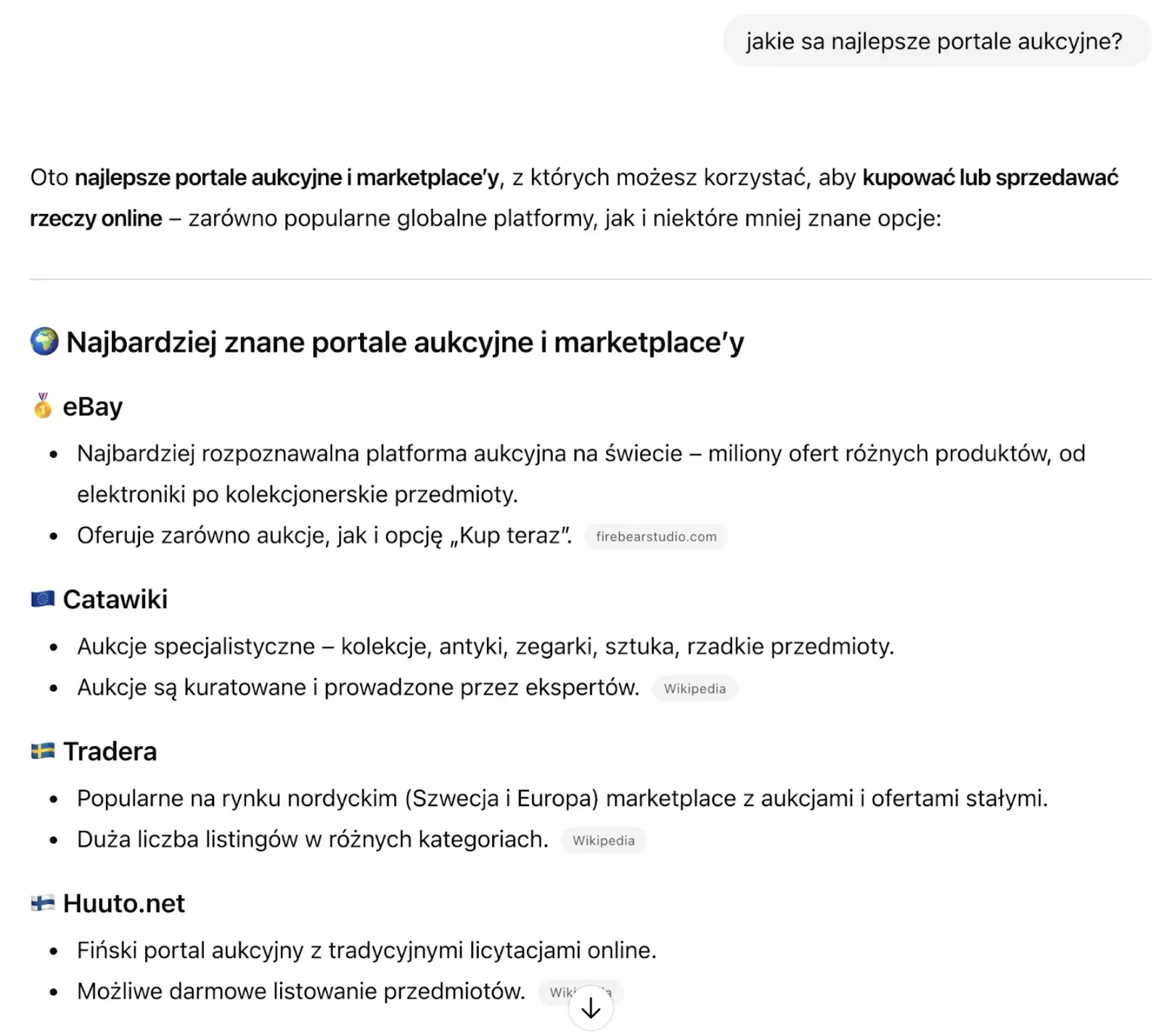
Local players are invisible compared to international giants – Source: Peec AI
This linguistic shift is not neutral, as it directly influences the selected sources, and therefore the companies highlighted.
For example, in a test conducted In Poland, a query in Polish about the "best auction portals" relegated Allegro, the local market leader, to second place in favor of international players like eBay. The same pattern was observed in Germany, where a question in German about the "best software companies" did not generate any German companies in the results. In Spain, searches for "cosmetics brands" excluded national players, while brands like Zara or Mango were cited via English-language sources.
The report also highlights that ChatGPT can implicitly reformulate queries by adding qualifiers like "global", which mechanically steers results towards international content.
A structural bias linked to the web ecosystem
While this bias towards English is a valid question, several hypotheses emerge.
First, English largely dominates the web, with approximately half of online content written in this language. Authority signals, such as links, citations, and reputation, are more abundant and easier for an AI model to interpret. Furthermore, querying English-language sources helps to reduce the risk of incomplete responses, because from an algorithmic perspective, expanding the linguistic scope maximizes the probability of finding structured and well-referenced content. Today, for French, German, or Spanish companies, the stakes go beyond traditional SEO, and visibility in AI-generated responses could now depend, at least in part, on a strategic presence in the English-speaking ecosystem…
Comments