


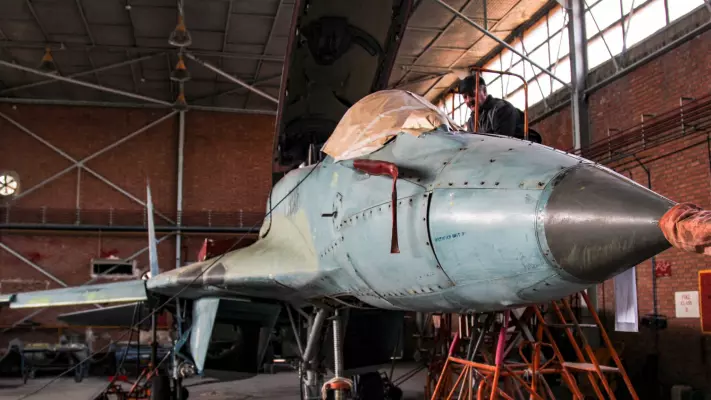
It still possesses F-14s from the movie Top Gun: why the Iranian air force offered no resistance to the Americans and Israelis

When the United States and Israel launched Operation Epic Fury on February 28, 2026, one detail struck military analysts: Iranian airspace was almost devoid of Iranian fighter jets. In just a few days, Western forces took control of the airspace without any real aerial combat.
A paradoxical situation for a country often presented as one of the major military powers in the Middle East. The reason is simple: the Iranian air force is one of the oldest in the world.
A lightning air campaign
From the very first hours of the offensive, American and Israeli strikes targeted Iranian command centers, radar installations, and air bases.
Stealth aircraft like the Israeli F-35I "Adir" played a central role in this initial phase, enabling the rapid neutralization of air defenses and the striking of strategic military infrastructure.
One of them, incidentally, even shot down an Iranian Yak-130 fighter jet above Tehran. But the aircraft in question is a military training model for Iranian pilots. In any case, it is the first time in nearly 40 years that the Israeli Air Force has engaged in air combat against a manned aircraft.
In a few days, the Western coalition achieved air superiority over Iran. Such dominance that most Iranian fighter jets remained grounded to avoid being destroyed.
A Fleet Inherited from the Shah
The Islamic Republic of Iran Air Force still relies largely on aircraft acquired before the 1979 revolution and primarily... from the United States.
During the Shah's era, Iran was one of the main allies of the Soviet Union in the region and possessed one of the most modern air forces in the Middle East. Tehran had purchased several hundred American aircraft, including the famous Grumman F-14 Tomcat, made legendary by the film Top Gun. As this 1973 article in the New York Times explained, the sale of this fighter jet to Iran helped offset losses for its manufacturer, Grumman. Interestingly, the $14 million at the time is equivalent to $100 million today, a price comparable to that of a modern F-35 fighter. But the problem is that even today, Iran remains the last country in the world to operate this aircraft. aircraft.
Last June, the Israeli army boasted of having bombed two of them at an Iranian base.
The Iranian fleet will mainly still consist of about ten F-14 Tomcats, according to the Military Balance 2024 report by the International Institute for Strategic Studies (IISS), but also about sixty McDonnell Douglas F-4 Phantom IIs and thirty Northrop F-5 Tiger IIs.
In addition to these American aircraft, there are some planes of Russian or Soviet origin, notably Mikoyan MiG-29s and Sukhoi Su-24s.
But most of these planes date from the 1960s or 1970s.
Fifty years of sanctions
After the 1979 Islamic Revolution, relations between Tehran and Washington were severed. The United States has imposed a total military embargo, depriving Iran of access to Western spare parts and technology. For nearly half a century, Iran has maintained its fleet in flying condition through reverse engineering, local manufacturing of parts, smuggling, and cannibalization of aircraft. However, the clashes of the past year may have further reduced these numbers. The number of aircraft actually capable of flying is probably lower than the reported figures, as some planes have been dismantled for spare parts.Conversely, Israel and the United States possess much more modern and capable aircraft, including the fifth-generation F-35 Lightning II stealth fighter and the F-22 Raptor, as well as highly advanced fourth-generation aircraft such as the F-16 Fighting Falcon and F-15 Eagle. As a result, of the 250 to 300 Iranian aircraft officially in service, only a portion are believed to be truly operational. A different strategy: drones versus missiles. While the Iranian air force lags considerably behind, Tehran has invested heavily in other military technologies. Over the past fifteen years, the country has become one of the world leaders in military drones. The best-known models are the Shahed-136, a long-range kamikaze drone capable of being launched in swarms, and the The Mohajer-6 is used for reconnaissance and precision strikes. These drones are inexpensive—no more than a few tens of thousands of dollars—and can be produced locally despite sanctions. This expertise is not new. Iran gradually became a military drone power, starting in the 1980s. During the Iran-Iraq War, the country began developing its first reconnaissance drones to monitor enemy positions, unable to purchase modern weapons after the Islamic Revolution. Under the weight of international sanctions, Tehran relied on these inexpensive technologies to compensate for its military lag. The program accelerated in the 2010s with the development of armed drones like the well-known Shahed series. But it is especially in the last five years that Iran has gained global visibility, as its drones have been used in several conflicts, notably by Russia in the war against Ukraine. For Iran, drones thus compensate for its air inferiority. This approach aligns with Iranian military doctrine: avoiding direct confrontation with Western armies and favoring asymmetric warfare. But drones do not control the skies. The problem, as Operation Epic Fury demonstrated, is that drones cannot replace a true combat aircraft force. While they can certainly strike infrastructure, harass an adversary, and threaten civilian transport, as in the Strait of Hormuz, they cannot establish air superiority to protect territory. But they can allow one to sustain a war of attrition.
The exorbitant cost of interceptor missiles and their limited availability are also important factors.
Kelly Grieco, a strategic and military analyst at the Stimson Center in Washington, estimates in the Guardian that intercepting a drone costs five times more than producing one, while US weapons stocks are very limited and can only be replenished slowly.
To go further -> Iranian drones at $20,000 versus American missiles at $4 million: the equation is brutal for the United States, can they hold out?
Please Login to leave a comment.
Want to Post Your Topic
Join a global community of creators, monetize your content easily. Start your passive income journey with Digbly today!
Post It Now
Comments