For example, a question about chemistry might trigger the display of an interactive periodic table, while a financial topic might lead to a graph illustrating its evolution.
This integration marks a break from the "Artifacts" feature, which already allowed for the generation of visual content, but in a separate space and with a logic more geared towards exportable creation.
An interaction designed to evolve with the user
One of the major contributions of this new feature lies in its interactive nature, as the visuals are not static and can be manipulated, explored, and adjusted directly by the user. It thus becomes possible to click on certain elements, ask for clarification, or even modify the representation during the conversation.
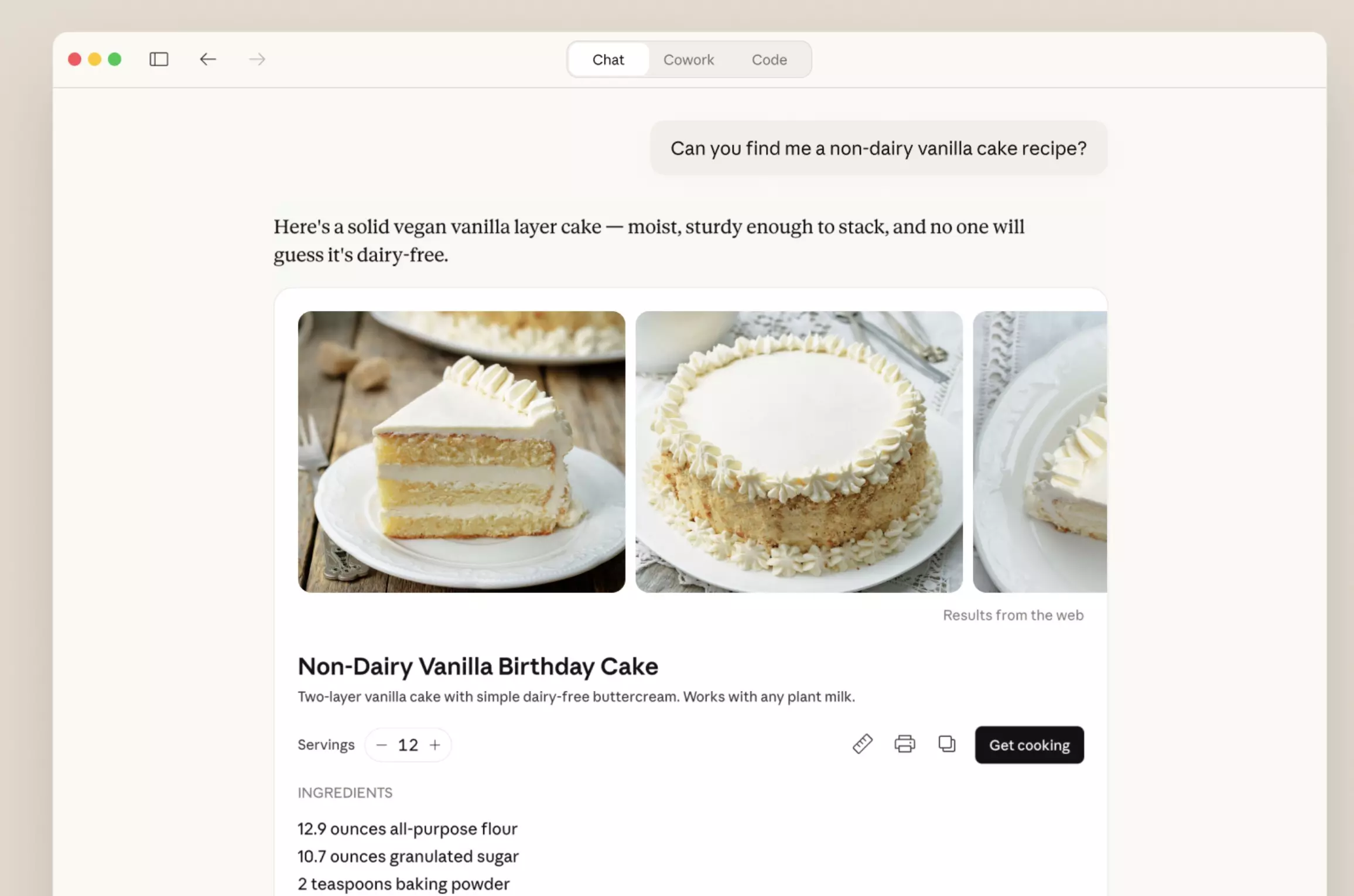
In concrete terms, this means that these visuals operate within a dynamic framework. They evolve based on interactions and remain accessible in the history, unlike "Artifacts" which are designed to be isolated and reused outside of the chat. Anthropic also takes integration further by offering formats adapted to specific uses, such as recipes or weather forecasts. Connections with tools like Figma and Canva are also mentioned, opening the door to more creative or professional uses.
A fundamental trend in conversational AI
With this evolution, Anthropic is part of a broader market dynamic, as other players, such as Google with Antigravity, are also exploring visual formats to enrich interactions.
Anthropic now wants to go beyond the limitations of text to offer a more intuitive experience, particularly in educational or analytical contexts. While some competitors primarily target education, Claude adopts a more generalist approach, capable of adapting to a wide variety of use cases…





Comments