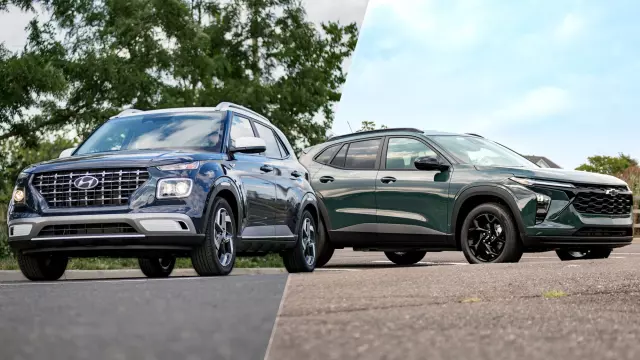
I drove the Chevrolet Trax and Hyundai Venue for a week — here’s the sub-$30K SUV I’d buy with my own money
- Tags
- Vehicle Tech
- SUV review
- Car comparison
- Chevrolet Trax
- Hyundai Venue
- subcompact SUV
Introduction: The Hunt for Affordable Sub-$30K SUVs
Finding a brand-new vehicle for under $30,000 has become an increasingly daunting task in today's automotive market, especially when many of the best electric cars and modern crossovers easily eclipse the $50,000 mark. Fortunately, budget-friendly options still exist, and two of the most popular subcompact SUVs on the market—the Chevrolet Trax and the Hyundai Venue—prove that you don't have to break the bank to get behind the wheel of a versatile crossover.
Subcompact SUVs brilliantly bridge the gap between the efficiency of smaller sedans and the utility and elevated ride height of crossovers. To see which vehicle truly reigns supreme for budget-conscious buyers, I spent an immersive week driving both the 2026 Chevrolet Trax 1LT and the 2026 Hyundai Venue SEL. With as-tested prices of $27,975 and $24,440 respectively, they offer a fascinating look at what you get when you prioritize affordability.
Chevrolet Trax vs. Hyundai Venue: Specifications
Before diving into the driving dynamics and interior comfort, let's look at how these two subcompact contenders stack up on paper:
- 2026 Chevrolet Trax 1LT Price Tested: $27,975 (MSRP: $23,200)
- 2026 Hyundai Venue SEL Price Tested: $24,440 (MSRP: $22,600)
- Engines: ECOTEC 1.2L Turbo 3-Cylinder (Trax) vs. 1.6L DOHC 4-Cylinder (Venue)
- Horsepower: 137 hp (Trax) vs. 121 hp (Venue)
- Combined Fuel Economy: 30 mpg combined (Trax) vs. 31 mpg combined (Venue)
Design and Aesthetics: A Tale of Two Styles
Automakers often cut corners on exterior styling when building vehicles at this price point, but both the Trax and the Venue manage to turn heads with distinct, appealing aesthetics.
The Hyundai Venue takes heavy inspiration from the Mini Cooper playbook, utilizing a boxy, upright proportion paired with a contrast two-tone roof. It gives the Venue a quirky, youthful flair that stands out brilliantly, even when compared to its larger sibling, the Hyundai Kona.
On the flip side, the Chevrolet Trax goes for a much sleeker, aggressive look. Reminiscent of the larger Chevrolet Blazer, the Trax features a lower stance, wider body, sculpted body lines, slim LED daytime running lights, and a subtle rear spoiler. It gives the Trax a commanding, outdoor-ready road presence.
Design Winner: Chevrolet Trax
Real-World Fuel Economy
While hybrids often steal the spotlight for fuel efficiency, neither the Trax nor the Venue are hybrids—yet both promise and deliver remarkable, sedan-like fuel economy.
On paper, the Venue is rated at 31 mpg combined, while the Trax sits closely behind at 30 mpg. However, real-world testing shattered those expectations. Over 133.1 miles of mixed driving, the Hyundai Venue averaged a staggering 37.8 mpg, peaking at an incredible 49.6 mpg on short-distance trips and 40.6 mpg on long highway stretches. Meanwhile, the Chevrolet Trax delivered a very respectable 34.8 mpg over 161 miles, with a long-distance peak of 38.4 mpg.
Fuel Economy Winner: Hyundai Venue
Driving Performance and Powertrains
Both subcompact SUVs benefit from small footprints and tight turning radii, making them exceptionally easy to maneuver in crowded city streets and tight parking lots. However, when it comes to an engaging drive, one clearly pulls ahead.
The Chevrolet Trax is powered by an Ecotec 1.2-liter turbocharged three-cylinder engine that churns out 137 horsepower and a robust 162 lb-ft of torque. That turbocharger makes all the difference, providing zippy acceleration that gets the vehicle moving with confidence. Combined with its wider stance and longer wheelbase, the Trax feels composed and stable around corners and at highway speeds.
In contrast, the Hyundai Venue SEL relies on a naturally aspirated 1.6-liter inline-four engine producing 121 horsepower and 113 lb-ft of torque. While adequate for neighborhood errands, it feels noticeably lethargic when attempting to merge onto fast-moving freeways.
Driving Performance Winner: Chevrolet Trax
Interior Comfort and Practicality
Budget vehicles often compromise heavily on cabin quality, which is immediately noticeable inside the Hyundai Venue. The interior feels dated, featuring an abundance of hard plastics and a small infotainment screen that washes out in direct sunlight. Furthermore, rear passengers are shortchanged with just 34.3 inches of legroom, and cargo capacity is limited to 18.7 cubic feet.
The Chevrolet Trax 1LT offers a vastly superior cabin experience. It features jet engine-inspired air vents, vibrant yellow contrast stitching, expansive rear legroom (38.7 inches), and a generous 25.6 cubic feet of cargo volume. It successfully balances passenger comfort with everyday utility.
Comfort & Practicality Winner: Chevrolet Trax
Value and Features
Separated by roughly $3,500, the Hyundai Venue appeals with its lower out-of-pocket cost and Hyundai’s stellar 10-year/100,000-mile powertrain warranty. However, it lacks crucial modern conveniences.
The Chevrolet Trax 1LT justifies its slightly higher $27,975 price tag by packing in incredible value: a power sunroof, heated steering wheel, heated front seats, and—most importantly—adaptive cruise control, a feature entirely missing on the Venue.
Value Winner: Chevrolet Trax
The Final Verdict
The 2026 Hyundai Venue SEL deserves praise for its attractive starting price and phenomenal real-world fuel economy. However, the 2026 Chevrolet Trax 1LT earns my ultimate recommendation as the sub-$30K SUV I would spend my own money on. With punchier turbocharged performance, superior interior space, a larger cargo hold, and advanced driver-assist features like adaptive cruise control, the Trax delivers unmatched value and refinement.
Comments (0)
Sign in to join the conversation.Sign in
Loading comments...