I tested the Apple Watch 12's heart rate accuracy vs a chest strap for running, cycling, HIIT and strength workouts — here's my verdict
- Tags
- Apple Watch
- Tech Reviews
- Fitness Trackers
- Smartwatches
- Running
- Heart Rate Accuracy
Introduction
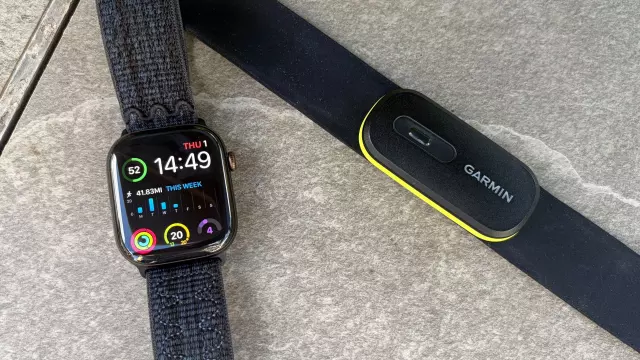
Ever since Apple updated the optical heart rate sensor on the Apple Watch Series 4, the tech giant's smartwatches have consistently ranked among the most reliable devices for tracking pulse during workouts. With the release of the Apple Watch Series 12 and the Apple Watch Ultra 4, Apple promises the most accurate heart rate tracking on the market, backed by rigorous in-house studies referencing industry-standard equipment like the Polar H10 chest strap. To see if these claims hold up in real-world scenarios, I put the Apple Watch 12 through extensive testing against a Garmin HRM 600 chest strap across multiple disciplines: running, indoor cycling, high-intensity interval training (HIIT), and weightlifting.
How I Tested the Apple Watch 12
To establish a reliable baseline, I wore the Apple Watch 12 on one wrist while pairing the Garmin HRM 600 chest strap to a reference device on the other. Chest straps remain the gold standard for consumers because they capture direct electrical impulses from the heart rather than relying on wrist-based optical sensors, which use light to measure pulse. While chest straps offer superior speed and accuracy during rapid heart rate shifts, watches are undeniably more comfortable for day-to-day wear. Throughout the testing period, I logged over 100 miles of running, multiple indoor cycling sessions with sprint intervals, and various gym-based strength and bodyweight workouts, meticulously cross-referencing all data via the DC Rainmaker Analyzer tool.
Apple Watch 12 Heart Rate Accuracy: Running
Running is my primary sport, and the Apple Watch 12 delivered impressive results across dozens of training miles and a half marathon race. Once the watch established an initial lock, its optical sensor closely mirrored the continuous readings of the chest strap. While optical wrist sensors occasionally drop signal or gray out briefly at the start of a run if confidence is low, the Series 12 performed notably better in this regard than its sibling, the Apple Watch Ultra 4, which frequently stalled during my tests. Although it occasionally lagged behind the chest strap during sudden accelerations—a common limitation for wrist-based tech—it proved more than reliable enough to guide structured heart rate training.
Apple Watch 12 Heart Rate Accuracy: Indoor Cycling
During a 40-minute indoor cycling session featuring interspersed 30-second sprint intervals designed to spike my heart rate, the Apple Watch 12 truly shone. Despite the abrupt transitions in effort, the watch reacted rapidly, yielding an average heart rate of 109.97 bpm compared to the chest strap's 109.89 bpm. While a microscopic lag was visible on the comparison graphs when explosive intervals began, the Series 12 successfully captured every single spike, proving it to be a dependable companion for spin classes and cycling workouts.
Apple Watch 12 Heart Rate Accuracy: Strength and HIIT Workouts
Gym environments present the ultimate stress test for optical heart rate sensors. Unlike steady-state running or cycling, unpredictable movements and heavy weightlifting introduce substantial wrist noise, forcing the sensor to filter out massive artifacts. In fact, the Apple Watch 12 automatically prompts users to connect a Bluetooth chest strap when starting a HIIT workout if reliability dips. During my strength training and bodyweight HIIT sessions—complete with explosive movements like burpees—the watch tracked general trends accurately but occasionally struggled with micro-fluctuations. It lagged behind the chest strap and missed a couple of minor effort spikes, confirming that dedicated athletes focusing on high-intensity functional fitness may still prefer a chest strap or optical armband.
The Verdict
The Apple Watch 12 delivers exceptional performance and stands shoulder-to-shoulder with the best fitness-focused smartwatches on the market, including top-tier Garmin models utilizing the Elevate v5 sensor. However, it does not represent a revolutionary leap forward compared to its predecessors. For standard running, cycling, and general fitness tracking, the Apple Watch 12 is brilliant. But if you rely heavily on precise, real-time heart rate data for high-intensity interval training or heavy lifting, investing in a chest strap remains a smart choice.
Comments (0)
Sign in to join the conversation.Sign in
Loading comments...