Beyond the Bulk: Hands-On with Meta's Revolutionary New VR Glasses
- Tags
- Wearable Tech
- Meta
- Smart Glasses
- Meta Connect 2026
- Virtual Reality
- Qualcomm
The End of the 'Bucket' Era
For years, virtual reality has been hampered by a singular, glaring issue: the form factor. To experience high-fidelity digital worlds, users have had to strap what can only be described as a 'plastic bucket' to their faces—bulky, isolating, and often uncomfortable headsets that feel more like industrial equipment than consumer electronics. However, at Meta Connect 2026, a glimpse into the future suggested that the era of the clunky headset is officially coming to an end.
Meta's latest venture into wearable tech isn't just another iterative update to the Quest line; it is a fundamental reimagining of how we wear VR. These new Meta VR Glasses bridge the gap between the immersive power of a Quest headset and the lightweight convenience of AR glasses, offering a glimpse into a world where high-end computing is practically invisible.
Design and Hardware: Sophistication in Simplicity
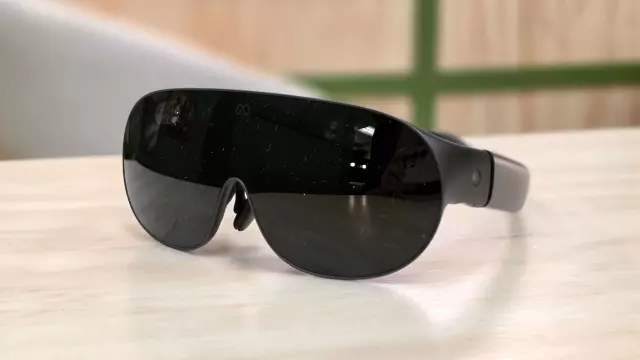
At first glance, the Meta VR Glasses resemble high-end aviation goggles rather than a gaming peripheral. The design philosophy here is clear: move the weight away from the face. By stripping the headset down to just the lenses, sensors, and display, Meta has achieved a staggering weight reduction. While a standard Meta Quest headset weighs roughly 500 grams, these glasses tip the scales at a mere 100 grams.
To achieve this, Meta utilized a tethered design. The processing power and battery are housed in a separate 'puck' that connects to the glasses. This puck is powered by the Qualcomm XR2 Gen 3 chipset (also known as the Snapdragon Reality Elite), which handles the heavy lifting and keeps the glasses from overheating. The trade-off is a physical wire, but the reward is a device that can be worn comfortably for extended periods without the dreaded 'VR face' pressure.
Visual Excellence: 5K Clarity
The visual experience is anchored by Micro OLED 5K "ultra-compact" pancake screens. These displays are not only Dolby Vision and Dolby color certified but also hold an IMAX certification—a potential first for the industry. This ensures that whether you are reading lines of code in a virtual workspace or watching a cinematic masterpiece, the image is crisp, vibrant, and free from the blurring often associated with early AR attempts.
Interaction: The Death of the Controller
One of the most daring moves Meta has made with this hardware is the move away from traditional controllers. While the glasses maintain Bluetooth support for Quest Touch controllers, the primary mode of interaction is through a sophisticated combination of eye-tracking and hand gestures.
The glasses feature sensors on both the front and underside to capture movement, allowing users to interact with the digital interface without having to lift their arms into the air. In a natural motion, a user can simply look at an icon and pinch their fingers to select it, all while keeping their hands resting comfortably in their lap or on a desk. This "instinctual computing" removes the barrier between the user and the machine, making the experience feel far more organic than previous VR iterations.
Content and Use Cases: More Than Just Gaming
Interestingly, Meta's presentation focused less on gaming and more on lifestyle and productivity. The device is positioned as a versatile media and work hub. Highlights from the hands-on demos included:
- Virtual Workstations: The ability to project multiple, crystal-clear screens into a room, solving the readability issues that have plagued previous smart glasses.
- Immersive Cinema: 360-degree 3D environments, including collaborations with Lionsgate and James Cameron, which turn movie-watching into a theme-park-like experience.
- Spatial Sports: A 180-degree spatial view of sporting events, such as the NBA Finals, allowing users to feel as though they are sitting courtside.
The Growing Pains: UI and Haptics
Despite the brilliance of the hardware, the software still requires refinement. During initial testing, the user interface (UI) struggled with "selection clarity." Icons merely brighten when looked at, which can be nearly indistinguishable on white backgrounds. A more defined border or color shift is necessary for a truly seamless experience.
Additionally, the "Surface Keyboard"—a virtual keyboard projected onto a physical table—lacks haptic feedback. Without the tactile sensation of a keypress, typing remains a clunky experience, suggesting that the industry may still need external haptic accessories to make virtual productivity viable.
Verdict: A Gliminary Step Toward Convergence
Expected to launch in Spring 2027 with a starting price of $1,299, the Meta VR Glasses are an ambitious leap forward. While the price point is steep, it sits comfortably between the budget-friendly Quest series and the luxury-tier Apple Vision Pro.
We are witnessing the beginning of a convergence where AI glasses, AR, and VR are merging into a single, wearable category. By eliminating the bulk and refining the interaction, Meta is moving VR out of the gaming den and into the real world. The clunky headset isn't just dead; it's being replaced by something far more elegant.
Comments (0)
Sign in to join the conversation.Sign in
Loading comments...