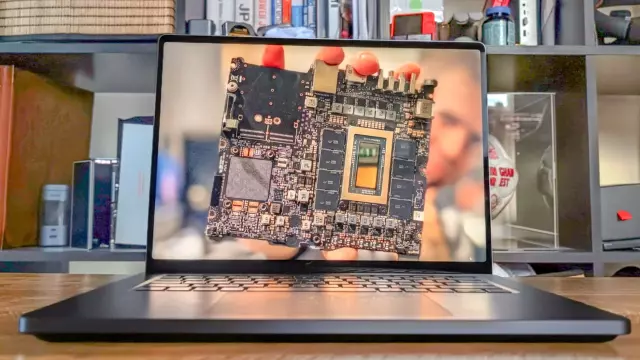
I've Been Living with Nvidia's RTX Spark for a Week — It’s Not a MacBook Pro Killer, But Something Much Weirder and Wildly Powerful
- Tags
- AI
- Laptops
- Nvidia
- MacBook Pro
- Surface Laptop Ultra
- RTX Spark
Introduction: Beyond the Benchmarks
If you are looking for raw benchmark data, thermal charts, and synthetic scores for Nvidia’s RTX Spark, you can check out live testing results. But numbers alone cannot explain what it actually feels like to use a machine equipped with a locally hosted AI brain. Living with Nvidia's RTX Spark on a Microsoft Surface Laptop Ultra requires unlearning years of cloud-tethered habits and treating your operating system like an overly eager digital intern. Over the past week, this shift has proven to be a fascinating breakthrough in personal computing.
Day 1: The Sims 4 Disaster and a Lesson in Patience
Unboxing the machine late at night sparked immediate excitement, leading to an unusual first test: installing Hermes agent with Qwen 3.8 Flash Next to play The Sims 4. The initial attempt was far from smooth. The AI fumbled through house-building menus and accidentally started a kitchen fire within three hours. Repeated prompts only caused the agent to loop in circles. However, this early failure taught a crucial lesson in local reinforcement learning: interacting with an onboard agent requires guidance and positive reinforcement, much like playing a co-op game with a beginner, rather than treating it like a standard search engine query.
Day 2: The Arrival of 'Jeeves'
By day two, the workflow evolved. By integrating the Hermes agent with a personal Google Workspace API and a browser-automation script, an AI assistant named 'Jeeves' was born. Every morning, a simple 'check-emails' prompt allows the agent to clear out spam, draft human-like responses, and prioritize daily tasks based on communication feeds. Powered by Nvidia’s CUDA architecture, the GPU handles open-source models with a distinct speed advantage over competitors, freeing up valuable morning hours.
Day 3: Embracing Creator Chaos
Mid-week tests focused on content creation, utilizing the massive Blackwell GPU alongside an open-source creative suite. Tackling ComfyUI allowed for node-mapping experiments, converting simple hand-drawn sketches into stylized 90s-style cartoon images and short video sequences via image-to-video pipelines. The local rendering speed outperformed comparable systems, demonstrating how local hardware can handle generative tasks efficiently without requiring a costly cloud subscription.
Day 4: Mutating Code and Webcam Magic
Gaming and productivity workflows revealed both the raw power and the unique capabilities of the RTX Spark. Demanding titles ran smoothly with DLSS and dynamic frame generation. When Red Dead Redemption 2 hit a compatibility block due to Arm translation, the local Hermes agent was instructed to resolve the issue. The AI successfully accessed the directory, rewrote the configuration code, and bypassed the restriction—a sci-fi-like capability for local hardware. Additionally, upgraded Nvidia Broadcast features enhanced webcam feeds in real-time during virtual meetings.
Day 5: The MacBook Pro Reckoning
By the end of the week, the hardware reality became clear. While the RTX Spark delivers a solid 10-hour battery life and impressive multi-core capabilities, it does not surpass Apple's M5 Pro and Max chips in raw CPU endurance or battery longevity. However, comparing it directly to a MacBook Pro misses the point. The RTX Spark represents a new category of device built for a future defined by local, self-rewriting, CUDA-accelerated intelligence rather than traditional performance metrics alone.
Comments (0)
Sign in to join the conversation.Sign in
Loading comments...