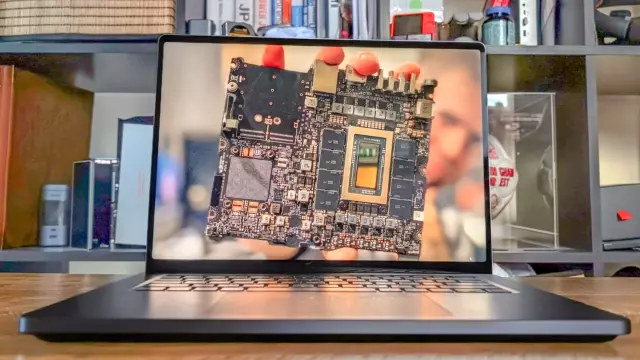
I’ve Been Living With Nvidia’s RTX Spark for a Week — It’s Not a MacBook Pro Killer, But Something Much Weirder and Wildly Powerful
- Tags
- AI
- Laptops
- Nvidia
- MacBook Pro
- Surface Laptop Ultra
- RTX Spark
Introduction: Beyond the Benchmarks
If you are looking for raw benchmark data, thermal charts, and synthetic scores for Nvidia’s RTX Spark, those metrics only tell part of the story. Living with a machine housing a locally hosted AI brain requires unlearning years of cloud-tethered habits and treating your operating system like an eager digital intern. After a week of ditching the M5 MacBook Pro for a Microsoft Surface Laptop Ultra powered by the RTX Spark alongside 128GB of unified memory, the experience proved to be a genuine breakthrough.
Day 1: The Sims 4 Disaster and a Lesson in Patience
Testing began not with productivity suites, but by deploying an agent framework with a Qwen model to play The Sims 4. Initially, the AI fumbled around the house-building menu and inadvertently started a kitchen fire. Repeatedly getting stuck by losing track of screen coordinates highlighted the early growing pains of autonomous local agents. However, shifting from frustration to positive reinforcement—much like playing a cooperative puzzle game with a novice—drastically improved the AI's performance, setting the stage for more complex tasks.
Day 2: The Butler Arrives
By day two, the agent was customized and integrated with Google Workspace and browser automation scripts to handle daily email management, filtering, drafting responses, and scheduling. The key performance driver here is Nvidia’s CUDA platform, which ensures that open-source models trained on Nvidia architecture run with remarkable speed compared to competing silicon. Offloading repetitive morning triage allowed for significant time savings before the workday even began.
Day 3: Embracing Creator Chaos
Mid-week tests focused on content creation, leveraging the Blackwell GPU's immense multi-core performance. Utilizing ComfyUI for node-mapping workflows, a simple hand-drawn sketch of Medusa was transformed locally within seconds into a 90s-style cartoon image and subsequently animated into a full video sequence. This local processing speed outperformed competing hardware and eliminated the need for premium cloud subscriptions.
Day 4: Mutating Code and Webcam Magic
Gaming and video conferencing pushed the system further. Demanding titles ran smoothly at high settings thanks to advanced frame generation features. When Red Dead Redemption 2 hit compatibility hurdles due to Arm translation blocks, the local AI agent actively rewrote configuration files to bypass the errors and boot the game successfully. Meanwhile, updated Nvidia Broadcast tools enhanced webcam feeds in real-time, elevating standard video calls.
Day 5: The MacBook Pro Reckoning
At the end of the week, the reality of hardware comparisons settled in. The RTX Spark is not a literal MacBook Pro killer; Apple’s M-series chips still hold an advantage in raw CPU speed and battery endurance, with the Surface landing around the 10-hour mark. Yet, judging the RTX Spark by traditional laptop standards misses its true purpose. It represents a shift toward self-rewriting, locally accelerated personal computing that redefines how users interact with their devices.
Comments (0)
Sign in to join the conversation.Sign in
Loading comments...