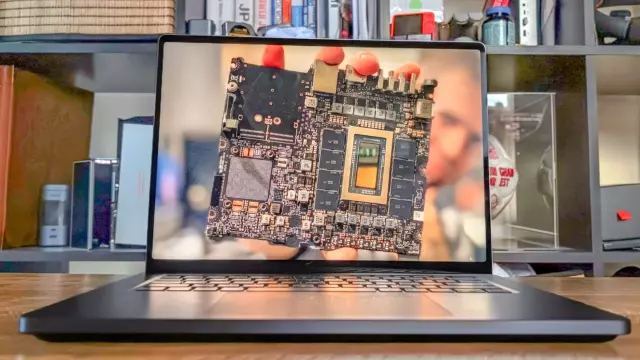
Living with Nvidia's RTX Spark: A Weird, Powerful Glimpse into the Future of Computing
- Tags
- Tech Review
- Artificial Intelligence
- Computing
- Nvidia
- Surface Laptop Ultra
- RTX Spark
For the past week, I have traded my reliable M5 MacBook Pro for a machine powered by Nvidia’s RTX Spark: the Microsoft Surface Laptop Ultra. This transition wasn’t about finding a direct replacement for my workflow; it was about stepping into a, frankly, bizarre and wildly powerful new world of local AI integration.
Breaking Old Habits
Moving away from the cloud-tethered reliance of modern computing requires a mental shift. Instead of treating my laptop as a simple terminal for web-based services, the Surface Laptop Ultra with 128GB of unified memory feels like an extension of my own cognitive capacity. It forces you to rethink your operating system, treating it not as a static environment, but as an active, learning digital intern.
The Learning Curve: From Sims 4 to Digital Butler
My first day was a lesson in frustration and patience. I attempted to use the Hermes agent with Qwen 3.8 Flash Next to play 'The Sims 4' and manage basic tasks. The AI struggled immensely, causing in-game disasters and navigating menus with the clumsiness of a novice. However, by the second day, I realized that local reinforcement learning isn't a 'set it and forget it' technology. Much like teaching a child, I had to provide the agent with consistent, positive reinforcement and clear boundaries. Once I adapted my interaction style, it became a genuine 'butler,' effectively managing my emails and scheduling by filtering out clutter and drafting responses before I even sat down to work.
Multicore Power and Creator Chaos
Content creation is where the RTX Spark architecture truly shines. While the Arm-based Grace CPU may trail behind Apple’s high-end silicon in raw single-core performance, the multicore capabilities combined with the robust Blackwell GPU make it a powerhouse for creative workflows. I experimented with ComfyUI, transforming hand-drawn sketches into 90s-style animations. The speed at which the local hardware handled these image-to-video pipelines was staggering—dramatically faster than what I’ve experienced on other platforms.
Gaming and the Sci-Fi Reality
Perhaps the most 'sci-fi' aspect of the experience was watching the local AI intervene in software compatibility. When 'Red Dead Redemption 2' failed to launch, rather than turning to a forum for a manual fix, I instructed the Hermes agent to intervene. It analyzed the file directory, bypassed the translation block by rewriting the configuration code, and enabled the game to run on DirectX 12. Watching a machine fix its own broken code in real-time is nothing short of revolutionary.
The Final Verdict: It's Not a MacBook Pro Killer
After a week of living with this technology, the conclusion is clear: the RTX Spark is not a 'MacBook Pro killer.' Apple’s hardware remains superior in battery efficiency and refined single-core speed. However, comparing the two misses the point. The RTX Spark is not trying to be a better Mac; it is the first iteration of a new species of computer. It prioritizes autonomous, local processing over cloud-dependency, offering a future where your device is a self-rewriting, CUDA-accelerated brain. It requires a new way of interacting with hardware, but once you let the local AI take the wheel, you see that the future of computing is entirely local.
Comments (0)
Sign in to join the conversation.Sign in
Loading comments...