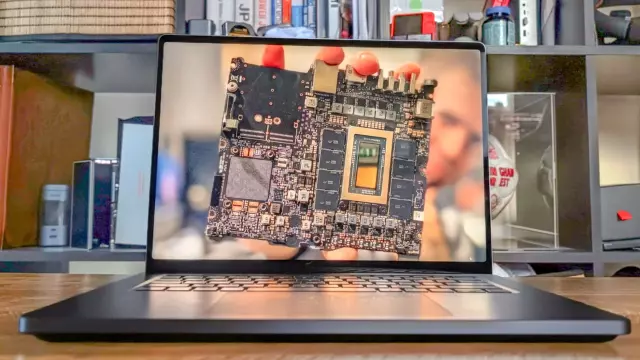
I’ve Been Living With Nvidia’s RTX Spark for a Week — It’s Not a MacBook Pro Killer, But Something Much Weirder and Wildly Powerful
- Tags
- Tech Review
- Artificial Intelligence
- Laptops
- Microsoft Surface
- Nvidia
- RTX Spark
- GPU
Introduction: Beyond the Benchmarks
Let me be clear from the top. If you are looking for the raw benchmark data, the thermal charts, and synthetic scores for Nvidia’s RTX Spark, you can check out live benchmarking feeds. But numbers and data don’t explain what it actually feels like to use a machine equipped with a locally hosted AI brain.
Using a local AI system requires unlearning years of cloud-tethered habits—like relying on browser-based chatbot tabs—and starting to treat your operating system like an eager digital intern. After spending a full week living exclusively with an Nvidia RTX Spark-powered Microsoft Surface Laptop Ultra, featuring 128GB of unified memory, the experience proved to be a remarkable technological breakthrough.
Day 1: The Sims 4 Disaster and a Lesson in Patience
Returning late from the Surface Laptop Ultra launch event in San Francisco, the excitement of unboxing the machine led to an unconventional first test: installing a local AI agent to play The Sims 4, build a house, and secure a job.
Initially, this test did not inspire immediate confidence. The AI fumbled through house-building menus and managed to start a kitchen fire within three hours. Repeated prompts only led to circular errors as the agent struggled with dynamic character coordinates.
However, this initial failure taught a crucial lesson in local reinforcement learning. Approaching the task the next morning with calm guidance—offering positive reinforcement rather than frustration—yielded significantly better results, culminating in a successful trip to the in-game gym. Interacting with a local agent resembles collaborative puzzle-solving rather than querying a search engine.
Day 2: The Arrival of the AI Butler
By day two, custom skills were integrated into the Hermes agent, hooking it directly into personal Google Workspace APIs and browser automation scripts.
Named "Jeeves," the agent handled daily email management—filtering out spam, drafting human-like responses to important messages, and generating prioritized to-do lists based on incoming communications and Slack notifications. While similar agents run on other hardware, Nvidia’s GPU architecture provides a distinct advantage through CUDA (Compute Unified Device Architecture). Because the vast majority of open-source models are initially optimized for CUDA, the processing speed and efficiency on RTX Spark systems offer a notable edge.
Day 3: Embracing Creator Chaos
Mid-week focus shifted to content creation, leveraging the Grace CPU's powerhouse multicore performance alongside the massive Blackwell GPU. Exploring ComfyUI revealed an intricate node-mapping interface. Feeding a hand-drawn sketch of Medusa into the system allowed the RTX Spark to render a 90s-style cartoon image and subsequently process an image-to-video pipeline within seconds—outperforming standard cloud tools and competing hardware in rendering speed.
Day 4: Mutating Code and Webcam Magic
Gaming performance on the RTX Spark proved exceptional, overcoming traditional ARM architecture hurdles by utilizing raw GPU power. Running titles like 007 First Light at high resolutions with advanced frame generation showcased seamless gameplay.
When an incompatibility error blocked Red Dead Redemption 2, the local AI agent stepped in, diving into the file directory and dynamically rewriting configuration code to bypass translation blocks. Additionally, upgraded Nvidia Broadcast features successfully transformed standard webcam feeds into polished, upscaled broadcasts in real time.
Day 5: The MacBook Pro Reckoning
Evaluating the machine against the MacBook Pro highlights fundamental differences. While the RTX Spark delivered a solid 10-hour battery life, it does not match Apple Silicon's endurance, and Apple’s M5 Pro chips outpace its CPU single-core speeds.
However, comparing the RTX Spark directly to a MacBook Pro misses the point. It is not an attempt to build a better Mac, but rather a preview of a new computing species—one designed to deliver a self-rewriting, fully autonomous, CUDA-accelerated digital brain directly to your backpack.
Comments (0)
Sign in to join the conversation.Sign in
Loading comments...