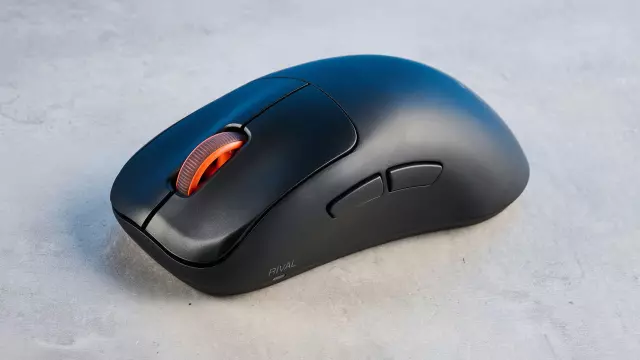
SteelSeries Rival Pro Review: A Game-Changer with 6GHz UWB Connectivity
- Tags
- Tech Review
- Gaming Peripherals
- SteelSeries
- Gaming Mouse
- Esports
- Rival Pro
Introduction
SteelSeries has officially re-entered the elite competitive mouse market with the launch of the Rival Pro and its symmetrical sibling, the Sensei Pro. Designed to bridge the performance gaps of traditional wireless setups, this elite esports mouse introduces 6GHz Ultra-wideband (UWB) connectivity, an 8K polling rate, and zero-downtime battery charging. In this detailed review, we put the Rival Pro through its paces over a month of heavy gaming and daily use to see if it truly justifies its $179 price tag.
Design and Build Quality
The SteelSeries Rival Pro is available in both ergonomic (Rival) and symmetrical (Sensei) profiles, as well as full-size and 'Mini' variants. Weighing in at just 53 grams for the Pro version and 49 grams for the Mini, the mouse feels remarkably lightweight and nimble in hand. Built from matte plastic, it allows for effortless gliding across any desk surface. However, users should note that the black version is a notorious fingerprint magnet, requiring regular cleaning to keep it looking pristine.
Performance and UWB Connectivity
The standout feature of the Rival Pro is its use of Ultra-wideband (UWB) connectivity running on the 6GHz band, a departure from the crowded 2.4GHz spectrum used by competitors like Logitech and Razer. By operating in a less congested frequency range, the Rival Pro eliminates micro-dropouts and dead zones, ensuring pinpoint cursor accuracy during high-stakes gaming sessions. Paired with up to 42,000 DPI sensitivity, 70G acceleration, and an oversampled 8,000Hz polling rate, cursor movements are exceptionally smooth and responsive.
Software and Customization
SteelSeries' GG app remains one of the more robust companion software suites in the peripherals market. It allows users to fine-tune polling rates, DPI profiles, acceleration curves, and button bindings on a per-game basis. Crucially, SteelSeries has also introduced a web-based configuration app, enabling users to adjust mouse settings on the fly across different computers without needing to install standalone software.
Battery Life and the Zero-Downtime System
One of SteelSeries' signature innovations is its zero-downtime battery system. The UWB charging hub features an integrated slot for a spare battery, meaning users can hot-swap power cells in seconds with zero interruption. Running at maximum 8K polling yields roughly 16 hours of battery life, while dropping back to 1,000Hz extends usage up to 60 hours. Because swapping batteries takes only moments, the single-cell runtime is rarely a hindrance.
The Downsides
While the Rival Pro excels in performance, it is not without minor flaws. The optical switches, while reliable and accurate, feel somewhat featureless compared to the adjustable analog magnetic switches found on elite alternatives like the Logitech G Pro X SuperStrike. Additionally, the $179 / £169 MSRP positions it firmly as a premium investment for hardcore competitive players only.
Verdict
The SteelSeries Rival Pro proves that SteelSeries is back at the top of its game. Thanks to its revolutionary 6GHz UWB connectivity, incredibly lightweight chassis, and seamless hot-swappable battery ecosystem, it offers distinct advantages over traditional 2.4GHz competitors. If you are a dedicated esports athlete or competitive shooter enthusiast looking for the most reliable connection and tracking precision available, the Rival Pro is an exceptional choice.
Comments (0)
Sign in to join the conversation.Sign in
Loading comments...