The Secret to Stopping Weeds Next Spring: Apply This Simple Barrier to Your Lawn Right Now
- Tags
- Gardening
- lawn care
- landscaping
- Weed Control
- Fall Yard Maintenance
Why Fall is the Ultimate Time to Stop Weeds
If you wait until spring to start fighting weeds in your yard, you are already months too late. While your lawn’s top growth slows down noticeably in the fall, troublesome cool-season weeds like chickweed, henbit, and annual bluegrass are actively germinating under the surface as soil temperatures begin to cool down.
By the time those vibrant green shoots pop up in April, those weeds have spent the entire winter establishing massive root systems across your yard. The true secret to securing a completely weed-free lawn next year isn't pulling mature weeds in the heat of summer; it is stopping them from ever breaking through the soil in the first place.
How Pre-Emergent Barriers Work
Pre-emergents don’t kill existing weeds or feed your grass; instead, they act as an invisible subterranean shield. While synthetic products are common, natural pre-emergents like corn gluten meal work on the exact same principle by preventing young roots from taking hold.
The critical catch is that pre-emergents block all seed germination indiscriminately. If you are currently overseeding or patching bare spots in your yard, skip the pre-emergent entirely until your new grass is fully established—typically after it has sprouted and you have mowed it at least twice. Otherwise, the barrier will kill your expensive grass seed before it ever takes root.
Once applied and watered in properly, the product settles securely into the top inch of soil to halt cell division right as winter weed seeds attempt to sprout.
Step-by-Step Guide to Applying Pre-Emergents
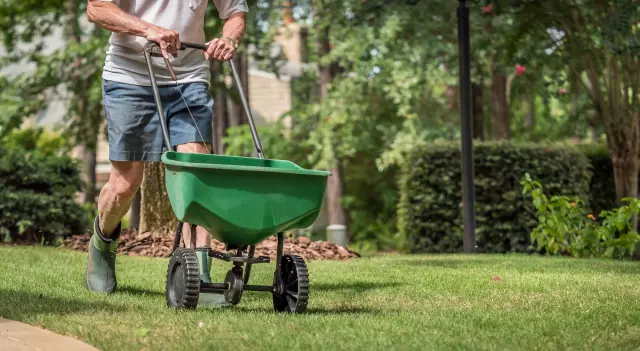
To apply the granules evenly across your turf, you will need a lawn spreader, which you push across the lawn to drop the product out from the bottom as you walk.
- Check the dial settings: Look at the back of your product bag to find the recommended setting for your specific spreader model, and turn the dial to match.
- Fill safely: Always fill the spreader's main bucket while parked on your driveway to avoid accidental, concentrated spills directly on your grass.
- Perimeter first: Walk the outer perimeter of your yard first. This creates a neat turnaround boundary so you don't accidentally dump extra product at the property lines.
- Pattern execution: Push the spreader back and forth in straight, overlapping lines. For the best coverage, use a cross-hatch pattern by passing over the lawn north-to-south, then east-to-west.
- Control the flow: Only open the bottom slot of the spreader while you are actively walking. Close it right before you stop or turn, or a heavy pile will dump out and burn your grass.
- Activate the barrier: Sweep any stray granules off your driveway and back onto the lawn. Finally, water the yard lightly for 10 to 15 minutes to activate the chemical barrier and lock it into the top layer of soil.
Comments (0)
Sign in to join the conversation.Sign in
Loading comments...