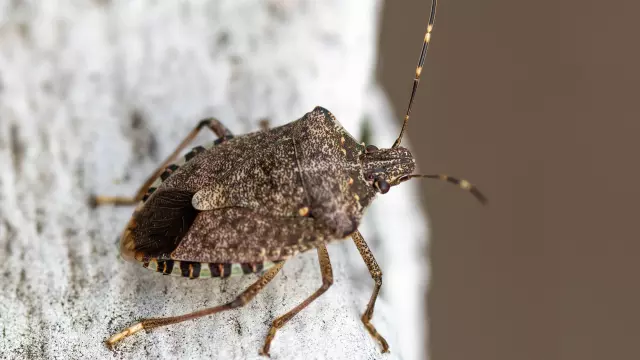
Why Are Stink Bugs Moving Into Your House — and How to Stop Them
- Tags
- Home Improvement
- pest control
- stink bugs
- autumn pests
- house maintenance
Why Are Stink Bugs Moving Into Your House — and How to Stop Them
As summer gives way to fall, changing temperatures prompt a whole host of seasonal pests to seek shelter. While spiders are common fall culprits, stink bugs are another persistent pest looking to make your home their winter retreat.
Pest control experts explain why stink bugs seek refuge in the fall and what we can do to discourage them from settling in our homes.
Why stink bugs invade our homes in fall
“Stink bugs typically make their way into homes in the fall as temperatures begin to drop, and they look for a protected place to shelter during the colder months,” says Emma Grace Crumbley, Entomologist at Mosquito Squad Plus.
She explains that stink bugs are cold-blooded insects and cannot regulate their body temperature the same way other animals can, which is why they seek sheltered, warmer areas when it gets chilly outside.
Our homes are a great place for stink bugs to over-winter, and according to Brandon Runyon, Entomologist at Swat Pest Management, “All those cracks and crevices make great places for their diapause.”
What’s the difference between diapause and hibernation?
Diapause and hibernation are both forms of dormancy to help animals save energy, but they work differently. Diapause is a genetically programmed pause in an organism’s physical development and growth, while hibernation is a seasonal slowdown of metabolic activity and deep sleep to survive the winter.
Do stink bugs search for food inside?
However, they don't come inside to find food. Crumbley says stink bugs feed on fruits, flowers, and crops outdoors and don’t typically enter our homes to eat; they usually come in to seek warmth.
How do stink bugs get inside?
These insects are sun seekers, Ed Dolshun, VP and Technical Director at Catchmaster, explains. “Stink bugs gather on the sunny sides of a building in the afternoon, and once they’re on the wall, they work their way into any gap they find.”
“A crack around a window frame, a loose siding seam, a utility line, an attic vent, or a gap along the foundation becomes a doorway,” he adds.
Stink bugs also cluster. When a few find a good spot to overwinter, Dolshun explains that more tend to show up in the same place.
How to keep stink bugs out
Once inside, stink bugs can be difficult to control, so Crumbley advises taking preventative measures to keep them out, and now is the perfect time to do it.
“Homeowners should inspect the exterior of the house for potential entry points and seal cracks or gaps around windows, doors, siding, vents, utility openings, and other areas where these pests may be able to get inside,” Crumbley advises.
Dolshun adds, “Repair torn screens, check your door sweeps, and look closely at openings around exterior trim.”
However, he says to avoid the quick fixes: “Indoor sprays and foggers only hit the bugs you can see, and more will keep coming out of wall voids and attics after the product dries.”
If you can’t keep on top of the problem, Crumbley says you may need to call in the professionals to help assess your home for potential entry points and create a pest management plan.
What not to do with stink bugs
If stink bugs do make their way indoors, Dolshun says don’t crush them, as it releases the odor you’re trying to avoid. Instead, he says, “Remove them by hand with a cup and a piece of paper, drop them into soapy water, or vacuum them up and empty the canister right away so the smell doesn't linger.”
Comments (0)
Sign in to join the conversation.Sign in
Loading comments...