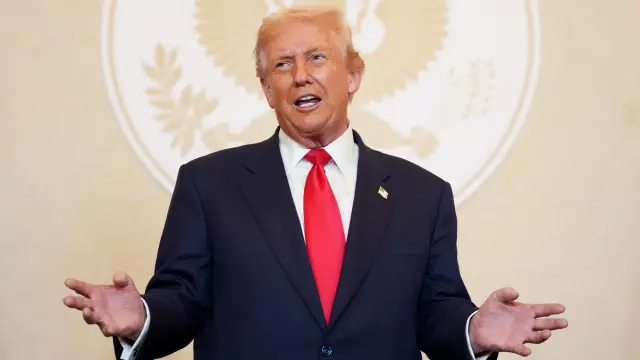
Why Trump’s Proposed Rebranding of AI as 'Super Intelligence' Matters
- Tags
- AI
- Artificial Intelligence
- Donald Trump
- Technology Policy
- Super Intelligence
- Future Tech
In a recent address to the United Nations General Assembly, former President Donald Trump announced that the United States government would officially shift its terminology for artificial intelligence, choosing to refer to the technology as 'Super Intelligence' (SI) instead. The announcement marks a significant, albeit potentially contentious, pivot in how the federal government frames the rapid advancement of modern computing.
The Move to 'Super Intelligence'
Trump argued that the prefix 'artificial' no longer accurately reflects the capabilities of today’s technology. During his speech, he declared, 'From this point forward, all of United States documents... will be changed to use the much more accurate term "super" as opposed to artificial.' He championed this rebranding as a reflection of the reality of modern systems, reinforcing his previous statements on social media that the U.S. should prioritize accelerating development over cautious regulation.
Why the Terminology is Controversial
While the rebranding may seem like a simple linguistic update, it has raised eyebrows among AI researchers and ethicists. The term 'superintelligence' is already an established concept in computer science. Generally, researchers define artificial intelligence (AI) in three distinct categories:
- Artificial Narrow Intelligence (ANI): The current standard, including generative AI like ChatGPT and image recognition software, which excels at specific, targeted tasks.
- Artificial General Intelligence (AGI): A hypothetical future technology capable of matching human-level intellectual abilities across a broad range of domains.
- Artificial Superintelligence (ASI): A theoretical, future-state system whose capabilities would surpass those of humans across every intellectual dimension.
By collapsing these definitions under the umbrella of 'Super Intelligence,' critics fear that the administration may create public confusion. When current tools—which are prone to hallucinations and errors—are labeled as 'super,' it may convey a false sense of infallibility to the general public.
Policy Implications and the Global Race
Beyond the semantics, this shift highlights the intense global competition over AI leadership. Trump’s rhetoric at the UN emphasizes a drive to dominate the AI landscape, particularly in relation to international competitors. The administration appears eager to avoid restrictive global agreements that might hinder domestic innovation. However, this stance puts the U.S. at odds with other nations advocating for strict safety protocols and standardized international control over how these powerful systems are developed and deployed.
Ultimately, whether the federal government’s new mandate to label AI as 'Super Intelligence' will influence broader industry standards remains to be seen. As of now, the tech industry continues to categorize its tools based on traditional technical benchmarks, while the debate over safety, regulation, and the true meaning of machine intelligence continues to escalate.
Comments (0)
Sign in to join the conversation.Sign in
Loading comments...